

Christian publishing is growing, not shrinking. U.S. Bible sales reached 19 million copies in 2025, the highest in 21 years, and younger readers are a big part of the reason. The seven trends shaping 2027 are: record demand for Scripture, a younger faith audience, audiobooks, human-written books in an AI age, readers outside the church, Spanish-language books, and authors selling directly to readers.
If you’re writing a Christian book right now, these aren’t just industry headlines. Each one affects a decision you’ll make, from the format you publish in to how you find your first hundred readers. We’ve pulled the numbers from Barna, Circana, Publishers Weekly and others, and put one plain next step under every trend.
In this article:
- Readers want Scripture more than they have in 20 years
- Gen Z and Millennials are coming back to faith
- Audiobooks are now expected, not a bonus
- Readers want books written by people, not AI
- Christian publishers are reaching readers outside the church
- Spanish-language Christian books are growing
- Authors are selling directly to readers
- The trends at a glance
- How to tell if a Christian publisher is legit
- FAQs
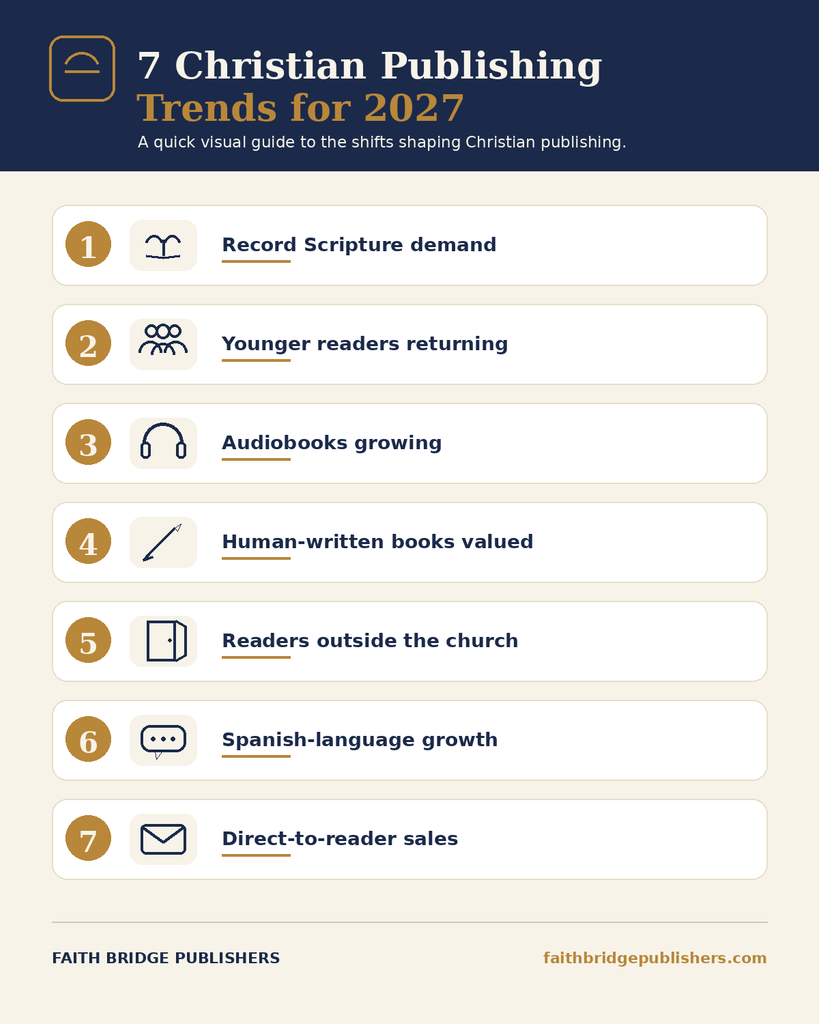
1. Readers Want Scripture More Than They Have in 20 Years
Bible sales and Scripture-based books are moving at their fastest pace in two decades.
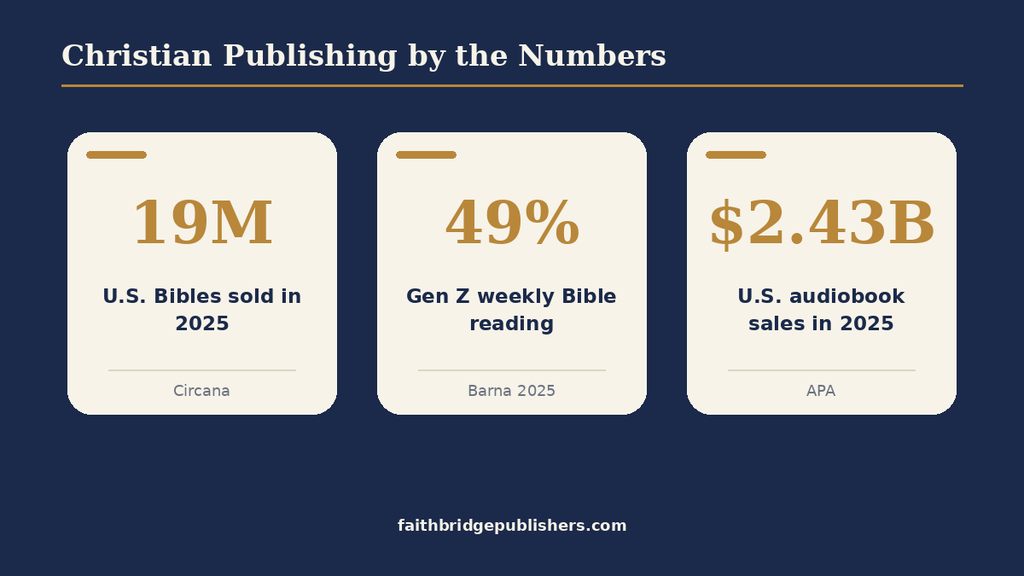
According to Circana BookScan, U.S. Bible sales hit 19 million units in 2025. That’s up 12% from 2024 and double the 2019 figure. HarperCollins Christian Publishing says it has had three record years in a row, and B&H describes its Bible sales as “skyrocketing.” Circana’s Brenna Connor said people are “turning to faith-based resources as anchors of stability and sources of comfort during uncertain times.”
When someone buys a Bible, they often go looking for help reading it. That’s where your book comes in.
What it means for your book: If your idea is built around Scripture, such as a devotional, a study guide, or a close look at one book of the Bible, you’re writing into real demand. Our Bible study publishing and devotional publishing pages cover what these books need. Check every verse reference before you publish. Readers who know their Bibles will notice, which is why a Scripture and Bible reference review is worth the time.

2. Gen Z and Millennials Are Coming Back to Faith
Younger adults are now some of the most engaged Bible readers in the country.
Barna’s State of the Church 2025 research found that weekly Bible reading among Gen Z jumped from 30% to 49% in a single year, and Millennials reached 50%. Church attendance is shifting too. Barna reports that Gen Z churchgoers now attend about 1.9 weekends a month, up from close to one weekend a month in 2020. For the first time in decades, young churchgoers are showing up more often than older ones.
That’s a big change for anyone who assumed Christian books mainly sell to readers over fifty.
What it means for your book: Write with a 24-year-old in mind, not only your church friends. Keep chapters short. Ask honest questions, including the ones without neat answers. Tell real stories instead of polished lessons. Then show up where younger readers spend their time, which usually means short video, podcasts and Instagram more than church bulletins. Christian author social media marketing can help you reach them.

3. Audiobooks Are Now Expected, Not a Bonus
More readers now listen instead of reading, so an audio edition is worth planning from the start.
The Audio Publishers Association reports that U.S. audiobook sales reached $2.43 billion in 2025, up 9% from the year before. Listening fits the way many people make room for faith in a busy week: a devotional on the drive to work, a testimony on an evening walk.
What it means for your book: Decide early whether you want an audiobook, because it affects your budget and your timeline. If your book is personal, like a testimony or a collection of sermons, think about narrating it yourself. Listeners connect with the author’s own voice in a way a hired narrator can’t always match.

4. Readers Want Books Written by People, Not AI
AI-written content is filling online bookstores. A real human voice, and a real testimony, is becoming what sets a Christian book apart.
The Evangelical Christian Publishers Association has published AI principles that call for human review, honest communication about AI’s role, and no content created without meaningful human involvement. Written Word Media’s 2026 author trends report also lists openness about AI use as one of the ways authors now earn trust.
For Christian readers, this goes deeper than taste. A testimony only means something if it really happened to the person telling it.
What it means for your book: If you use AI at all, keep it to background jobs like organizing notes. The writing, the stories and the theology should be yours. If AI played any part in your process, be ready to explain how. Then put your money into a human editor who understands Christian writing. That’s what Christian manuscript editing is for.

5. Christian Publishers Are Reaching Readers Outside the Church
Large Christian publishers are starting imprints for general-market readers. That tells you where they expect growth.
Publishers Weekly reported in 2026 that Christian houses are launching “faith-adjacent” imprints for readers who may not call themselves Christians, with books that don’t open with church language. Plenty of people are curious about faith but won’t pick up a book that assumes they already know the vocabulary.
What it means for your book: You don’t need to water anything down. Just ask yourself whether someone who has never been to church could follow chapter one. Explain words like “grace” or “sanctification” the first time they appear. Choose a title and cover that invite curious readers in, not only people who already agree with you. Christian author branding helps you get that first impression right.
6. Spanish-Language Christian Books Are Growing
Christian publishers are putting real money into Spanish-language books.
InterVarsity Press is launching its new imprint, IVP Español, with nine titles in 2026. When a publisher that size builds a whole imprint around a language, it’s a sign it sees long-term readership there.
What it means for your book: If your church or ministry serves Spanish speakers, plan a translation from the start instead of treating it as an afterthought. Work with a translator who knows Christian vocabulary, and have a native speaker from your own community read the draft before it goes to print.
7. Authors Are Selling Directly to Readers
How readers find books is moving away from store algorithms and toward email lists, church communities and AI search.
Penguin Random House Christian is building its own direct-to-reader platform. Written Word Media’s report points the same way: newsletters, book clubs and reader communities now do better than algorithm-driven discovery. And more readers are skipping the scroll entirely. They ask ChatGPT or Google’s AI something like “What’s a good Christian book on grief?” and read whatever it recommends.
What it means for your book: Start an email list now, before the book is finished. Talk to your pastor about a church launch or a small-group study built around your book; our church and ministry outreach service is built for this. Keep a simple author website with a clear bio and a plain description of your book, so both people and AI tools understand who you are and what you wrote. Then plan your book launch around the readers you already have.
Christian Publishing Trends 2027 at a Glance
| Trend | What it means | What to do this year |
|---|---|---|
| Record Scripture demand | Bible-based books have buyers | Build around Scripture and check every reference |
| Younger readers returning | Gen Z is reading the Bible weekly | Short chapters, honest questions, social video |
| Audiobooks growing | Listening is normal now | Plan audio early and think about narrating it yourself |
| Human-written books valued | AI content is everywhere | Keep your voice and hire a human editor |
| Readers outside the church | Publishers are chasing crossover readers | Explain church words, invite curious readers in |
| Spanish-language growth | New imprints are launching | Plan a translation if your community is bilingual |
| Direct-to-reader sales | Email lists and communities beat algorithms | Start your list and partner with your church |
How to Tell If a Christian Publisher Is Legit
A legit publisher is clear about cost, clear about your rights, and does real editing.
Growth brings new companies into Christian publishing, and not all of them treat authors well. Search Google and you’ll find plenty of writers asking whether a certain publisher is “legit” or “a vanity press.” Writer Beware is a good place to check a company’s name before you sign anything.
Red flags:
- Pressure to sign quickly or pay before you’ve seen a contract
- Vague packages with no clear list of what’s included
- Promises of guaranteed sales or bestseller status
- Unclear terms on who owns your rights and how royalties are paid
- Little or no real editing
Good signs:
- Written pricing with no hidden fees (our Christian book publishing cost guide shows what normal costs look like)
- A contract that spells out rights and royalties in plain words
- Named editors and designers you can actually talk to
- Scripture references checked, not skipped
- Real authors you can hear from, such as reviews from past authors
Still weighing your options? Our guide to self-publishing vs. traditional publishing walks through both paths.
Frequently Asked Questions
Yes. U.S. Bible sales reached 19 million copies in 2025, a 21-year high, according to Circana BookScan. Major Christian publishers are reporting record years and launching new imprints, which suggests they expect that growth to continue into 2027.
Bibles and Scripture-based books lead, including devotionals and Bible studies. Demand is also rising among Gen Z and Millennial readers, so books that speak honestly to younger adults, in formats like audio, have a real audience.
You can use AI for small background tasks, but the writing, stories and theology should be yours. Christian publishers’ own AI principles stress human involvement, and readers value a real voice. If AI played a part, be open about it.
In most cases it’s worth considering. U.S. audiobook sales grew 9% in 2025 to $2.43 billion. Personal books like testimonies and sermon collections work especially well in audio, above all when the author narrates.
Look for written pricing, a clear contract on rights and royalties, real editing, and past authors you can hear from. Be wary of pressure to sign fast, guaranteed sales promises, or vague packages. Check the company on Writer Beware before you pay anything.
Planning a Christian Book for 2027?
Every trend above points the same way: readers are looking for books that are honest, well made and rooted in Scripture. If that’s the book you’re writing, you’re in a good place. If you’re not sure where to start, our guide on how to publish a Christian book covers the steps, and how long it takes helps you plan the calendar.
When you’re ready to talk it through, Faith Bridge Publishers offers a free manuscript consultation. Call us at (209) 580-8869, email info@faithbridgepublishers.co.uk, or send us a message.
Faith Bridge Publishers is a Christian book publishing company in Burbank, California, offering editing, design, publishing and marketing for authors who write for God.
Which of these trends matters most for your book? Tell us in the comments.
About the author: Haziel Stavros is Marketing Manager at Faith Bridge Publishers, where he has helped Pastor J. Reynolds take his manuscripts to e-book and print.
Leave a Reply