

A book has two different kinds of parts.
One kind is structural. Title page, chapters, index.
The other is physical. Cover, spine, pages.
Most explanations mix the two. This guide keeps them separate, then covers both in full.
The Short Answer
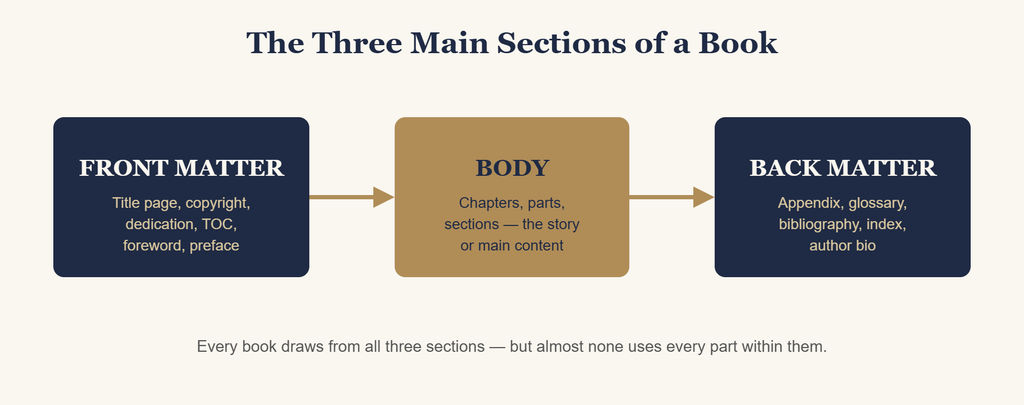
Authors commonly divide a book into three sections.
Front matter comes before the main text.
The body is the main text itself.
Back matter comes after it.
A printed book also has physical anatomy the cover, spine, pages, and binding. That’s a separate system from the three sections above.
Almost no book uses every part covered in this guide. Genre, format, and publisher all decide which ones apply.
Quick Reference
- Front matter
- Body
- Back matter
- Physical anatomy
Keep these four categories in mind. Everything below fits into one of them.
Front Matter: What Comes Before the Text
Front matter is everything between the front cover and chapter one.
It handles introductions, credits, and legal information. Most of it is optional.
Book designers assign separate lowercase Roman numerals to the front-matter pages. That’s one reason a printed book’s “page 1” isn’t always the first page you see.
Half-Title Page
This page shows only the book’s title. No author name, no subtitle.
It’s the very first printed page in many print books, sitting before the full title page.
Historically, it protected the more decorative title page during binding. Today it’s mostly a formatting convention, and many ebooks skip it entirely.
What Is the Title Page of a Book?
The title page states the book’s full title, subtitle, and author name.
It usually appears early in the front matter, on a right-hand page.
This is the page libraries and retailers treat as the book’s formal identity. It’s different from the cover: the cover is the exterior a reader sees on a shelf, while the title page is an interior page confirming those same details in print.
Nearly every published book includes one, print or digital.
Copyright Page
The copyright page carries the book’s legal and publication details.
That typically includes the copyright notice, publisher information, edition details, and the ISBN.
Publishers generally include it on the reverse side of the title page.
This page isn’t legal advice, and copyright rules vary by country.
For anything specific to your manuscript, a publishing team or attorney can confirm what your copyright page needs.
Dedication
A short line naming who the book is for.
Usually one sentence. Sometimes two.
It sits on its own page, shortly after the copyright page, and it’s entirely optional.
A dedication is personal. An acknowledgements section, covered later in this guide, is a related but different thing one names a person, the other thanks a group.
Epigraph
Writers use epigraphs by placing short quotations on separate pages before their stories or content begin.
It hints at the book’s theme without commentary.
This differs from a quote used inside the body text. A body quote supports an argument or scene. An epigraph just sits there, doing its work quietly before chapter one.
If you’re quoting anyone else’s words, confirm you have permission first. That applies even to short excerpts from lyrics or recent books.
Table of Contents
Does every book need a table of contents? No.
Nonfiction and reference books usually include one, since readers jump between sections.
Fast-paced fiction often skips it. A printed table of contents can hint at structure, but some authors would rather keep a surprise.
Ebooks are the exception. Most include a clickable table of contents even when the print edition doesn’t have a printed one, since digital readers expect it for navigation.
One small formatting note: most professionally edited books label this page “Contents,” not “Table of Contents.” The word “table” is redundant once the heading is already on the page.
Foreword
A guest writer, expert, or respected figure writes a foreword to introduce the author’s work and provide context for readers.
Often a mentor, an expert, or in Christian nonfiction a pastor or ministry leader who can speak to the book’s message.
It lends outside credibility. A reader trusts an endorsement more when it comes from someone besides the author.
When a book includes both a foreword and a preface, the foreword usually comes first.
Preface
Is a preface the same as an introduction? No.
Authors write prefaces to explain why their books exist and share the story behind how they came to be.
An introduction, covered next, deals with the subject matter itself rather than the author’s personal story behind the book.
A preface is optional, and it’s more common in nonfiction than fiction.
Introduction
An introduction orients the reader to the subject before the main chapters begin.
It’s common in nonfiction, especially books that build an argument or teach a skill.
Publishers determine its placement depending on the book’s structure and purpose. Some publishers treat it as front matter. Others treat it as the opening of the body, since it’s really the start of the actual content.
Either placement is fine. What matters is that it comes right before the main chapters start.
Front-Matter Terms Compared
| Term | Written By | Function |
| Foreword | Someone other than the author | Outside endorsement |
| Preface | The author | Personal context for the book |
| Introduction | The author | Context for the subject matter |
| Prologue | The author, in-story | Sets up the fictional narrative |
Prologue belongs to the body of the book, not the front matter. The next section explains it in detail.
Acknowledgements
Thanks to the people who helped make the book happen.
An editor, an agent, family, early readers, sometimes a note of spiritual gratitude in faith-based work.
It can appear in front matter or back matter. Both placements are common, and it’s always optional.
The Body of the Book
The body sits between the front matter and the back matter.
It’s the book’s actual substance. The story, in fiction. The argument or information, in nonfiction.
It has fewer named “parts” than front or back matter, even though it’s the longest section of the book itself.
Chapters, Parts, and Sections
Almost every book divides its body into chapters.
Longer or more complex books sometimes group chapters into larger “parts.” Think of a novel split into “Part One” and “Part Two.”
Individual chapters can also break into labeled subsections. This is common in nonfiction and rare in fiction.
There’s no fixed rule for chapter length. A chapter should be long enough to do its job, and short enough not to overstay its welcome.
What Is a Prologue?
A prologue is a short opening scene, told in the story’s own voice.
It might jump to a different time period, a different character, or an event that matters later.
A prologue is not the same as an introduction. An introduction explains real subject matter. A prologue is still part of the fictional story.
Editors consider it optional and debate whether it adds value or simply delays the start of chapter one.
Illustrations, Figures, and Tables
Where relevant, the body also carries visual content.
Photographs, illustrations, charts, and data tables all live here.
In children’s books, illustrations often carry as much of the story as the words do.
In textbooks and technical nonfiction, figures usually need their own numbering so the surrounding text can reference them.
Footnotes
Authors attach footnotes to specific points in the text and place them at the bottom of the corresponding page.
That’s different from an endnote, which is the same idea but collected at the back of the book instead. The back matter section explains endnotes in detail later in this guide.
Footnotes are common in academic nonfiction. They’re rare in fiction, though a few authors use them deliberately for effect.
Back Matter: What Comes After the Text
Back matter sometimes called end matter is everything printed after the main content.
It handles citations, definitions, extra context, and information about the author.
Epilogue
A closing scene, told in the story’s own voice, that wraps up loose ends.
It often happens some time after the main events. Sometimes it hints at a sequel.
Some style guides treat the epilogue as the final part of the body, since it’s still narrative content rather than back matter proper. Either way, it appears immediately after the last chapter.
It’s optional, and it’s fiction’s natural counterpart to a prologue.
Afterword
A closing note in the author’s own voice, reflecting on the book or the process behind it.
Unlike an epilogue, an afterword isn’t part of the story.
It’s more common in nonfiction and memoir than in genre fiction, and it’s always optional.
Appendix and Addendum
An appendix holds supplementary material that would interrupt the body if left in place.
Data tables, source documents, maps, extended technical detail all typical appendix content.
An addendum is different. Authors and editors add new material after the first printing to correct errors or update information in later editions.
People often use the two terms loosely and interchangeably in casual conversation. Strictly speaking, authors plan an appendix from the outset. An addendum is a later add-on.
Notes and Endnotes
End-notes serve the same purpose as footnotes attributing a source or adding a clarifying comment.
The difference is placement. Publishers place endnotes at the back of the book instead of adding them to the bottom of each page.
Publishers organize endnotes by chapter and connect each note to a numbered reference in the text.
Nonfiction authors often include endnotes to support factual claims and help readers verify information.
Glossary
An alphabetical list of terms used in the book, with short definitions.
It helps readers who hit specialized vocabulary, invented terminology, or unfamiliar language.
Authors include a glossary when their books use specialized terms that general readers may not know. Skip it if your book doesn’t rely on specialized language.
Bibliography, References, and Further Reading
People often confuse these three terms.
Researchers include every source they consult in a bibliography, whether or not they cite those sources directly.
Some style guides require authors to include only the sources they cite in the text when creating a reference list.
Further reading is different from both. It’s a curated recommendation list for readers who want to go deeper, not a record of your sources.
Nonfiction that cites outside material typically needs one of the first two. Most fiction needs none of them.
Index
An alphabetical list of key terms and topics, with the page numbers where they appear.
It sits at the very back of the book, after everything else.
Indexes matter most in reference books, textbooks, and nonfiction, as readers are likely to revisit rather than read start to finish.
Author Bio
A short paragraph about the author. Background, relevant credentials, sometimes a personal detail.
It can appear in back matter, on the back cover, or inside a dust-jacket flap for print books.
Readers expect this element across nearly every genre and format.
Book Credits
“Book credit” doesn’t have one single meaning.
Sometimes it means acknowledgements. Sometimes it means contributor credits an illustrator, a co-writer, a researcher.
It can also mean image credits or permissions for quoted material, usually noted on the copyright page.
Context decides which one applies. If someone asks about “credits” in your book, it’s worth clarifying which kind they mean.
Also-By and Coming-Soon Pages
A list of the author’s other books, or a preview of what’s next.
Common in series fiction and self-published work.
Its purpose is simple: point an engaged reader toward the next thing to read.
Discussion Questions
Prompts for book clubs, classrooms, or small-group study.
Common in book-club fiction, memoirs, and nonfiction including devotionals and Bible studies built around group use.
Authors include them when they expect readers to read, discuss, and analyze a book together.
Physical Parts of a Book
Everything above describes the book’s content. This section explains the physical materials and components that make up a book.
These are two separate systems. Confusing them is one of the most common mix-ups on this topic.
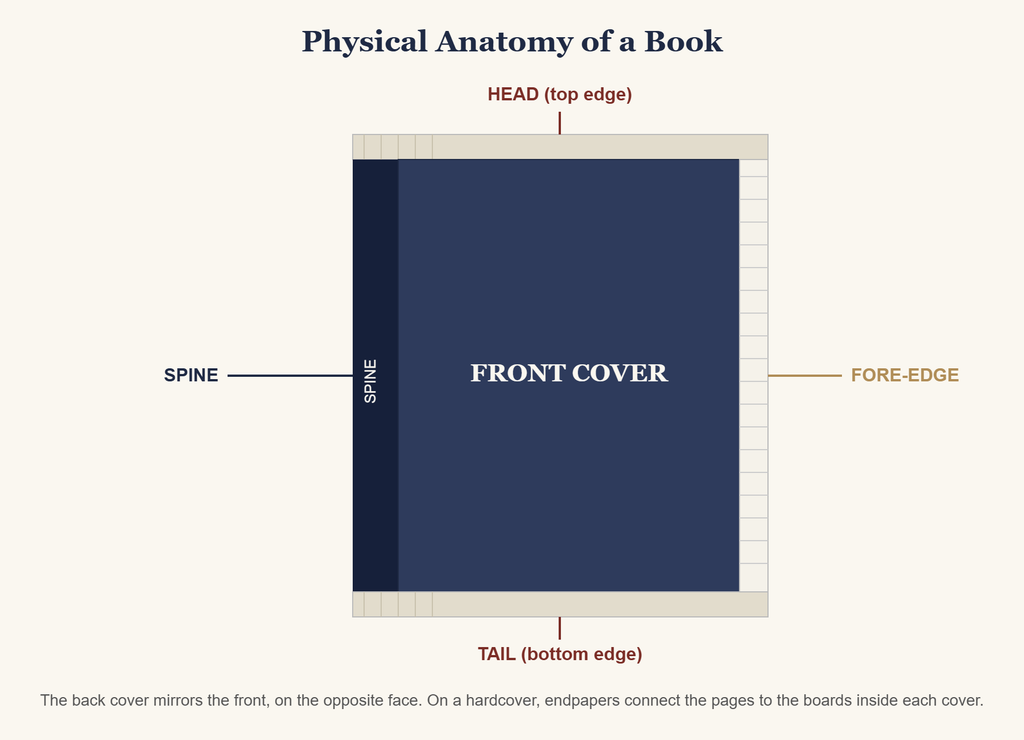
| Physical Part | What It Is |
| Front cover | The outward-facing panel at the front |
| Back cover | The outward-facing panel at the back |
| Spine | The bound edge connecting front and back covers |
| Dust jacket | A separate, removable wrapper on some hardcovers |
| Flaps | The folded-in edges of a dust jacket |
| Boards | The stiff structure under a hardcover’s outer material |
| Binding | How the pages are physically held together |
| Pages | Individual reading surfaces |
| Leaves | Physical sheets of paper, explained fully below |
| Gutter | The inner margin, closest to the spine |
| Fore-edge | The outer edge of the pages, opposite the spine |
| Head | The top edge, when the book stands upright |
| Tail | The bottom edge, when the book stands upright |
| Endpapers | Sheets connecting a hardcover’s boards to the pages inside |
| Text block | The full stack of printed pages before covers are attached |
What Is the Title Page of a Book vs. the Cover?
The cover is the exterior. It’s what a reader sees on a shelf.
The title page is an interior page. It confirms the title, subtitle, and author in print.
Both carry similar information. Only one of them is part of the book’s physical anatomy.
What Is a Leaf in a Book?
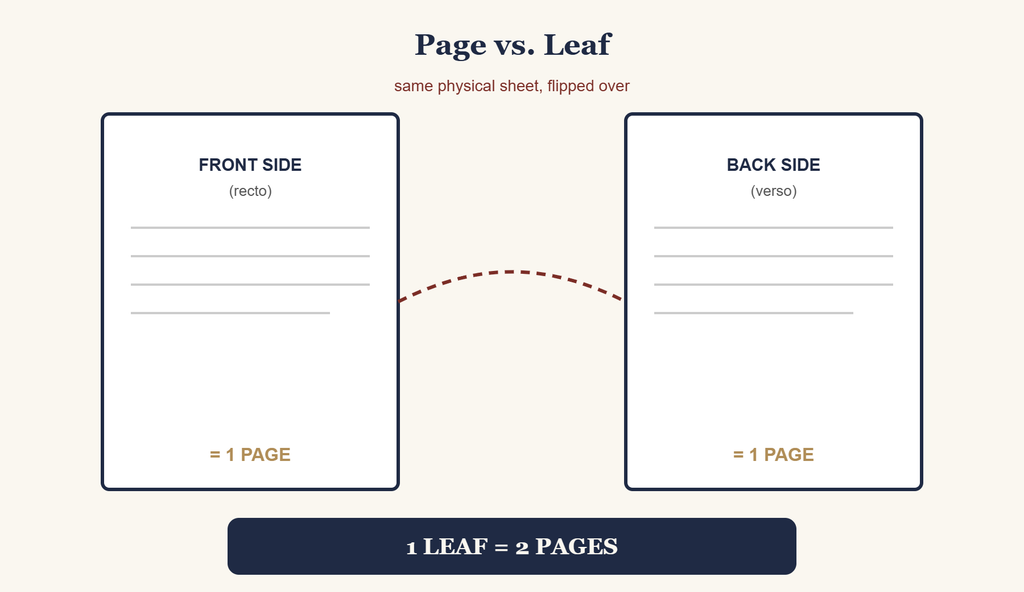
A leaf is one physical sheet of paper. A page is one side of that sheet.
One leaf equals two pages. The front side is the recto. The back side is the verso.
Flip a single leaf, and you’ve turned two pages at once.
Publishers often number front-matter pages separately using lowercase Roman numerals, which makes this detail important. The leaf in your hand and the number printed on it don’t always line up the way you’d expect.
Understanding the Parts at the Back of a Book
It depends on which “back” you mean.
The physical outer panel is the back cover.
The content after the main text is the back matter.
On a jacketed hardcover, the rear panel of the jacket is the back of the dust jacket, and the folded-in inside edge is the back flap.
People use these interchangeably in conversation. Publishing standards determine the correct answer for each specific question.
Learn What Publishers Call the Bottom Part of a Book
The tail. Some printers and binders call it the foot instead the terms vary slightly by tradition, but both point to the same edge.
It’s the bottom edge of the book when it’s standing upright on a shelf.
This is a physical term, not a content term. It has nothing to do with back matter, despite both loosely suggesting “the end.”
Spine vs. Binding
The spine is the outer edge itself the narrow strip connecting front and back covers.
Publishers use binding methods to assemble the pages and create the finished book. Perfect binding glues pages into a paperback cover. Casebound binding sews or glues pages into rigid boards for a hardcover. Saddle-stitching staples thin booklets together.
The spine is a part. Binding is a process. That’s the core difference.
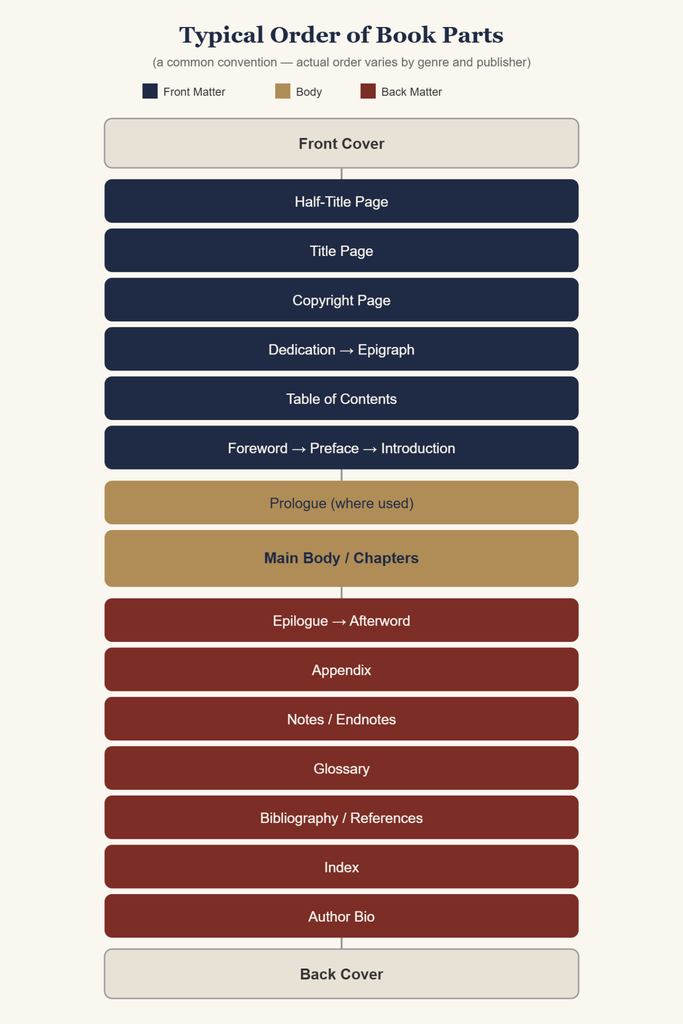
Parts of a Book in Order
Here’s a typical sequence, front to back.
Front cover → half-title page → title page → copyright page → dedication → epigraph → table of contents → foreword, preface, or introduction → main body → epilogue or afterword → appendix → glossary → bibliography → index → author bio → back cover.
This is a common convention, not a universal rule.
A thriller might skip the table of contents on purpose. A textbook might place the glossary before the index. An ebook might replace half the front matter with one clickable menu.
Required vs. Optional Book Parts
“Required” here means conventionally expected, not a legal requirement. Publishing conventions shift by genre, publisher, and country.
| Book Part | Typical Status |
| Title page | Commonly included |
| Copyright page | Commonly included |
| Author bio | Commonly included |
| Table of contents | Common in nonfiction, optional in fiction |
| Bibliography or references | Common when sources are cited |
| Half-title page | Often optional |
| Dedication | Often optional |
| Epigraph | Often optional |
| Foreword | Often optional |
| Preface | Often optional |
| Prologue | Often optional |
| Epilogue | Often optional |
| Appendix | Book-type dependent |
| Glossary | Book-type dependent |
| Index | Format dependent |
Terminology Comparisons
A quick-reference summary of the terms authors mix up most.
| Term A | Term B | The Difference |
| Preface | Introduction | Author’s own story vs. the subject itself |
| Foreword | Preface | Someone else writes it vs. the author writes it |
| Prologue | Introduction | Fiction device vs. nonfiction device |
| Epilogue | Afterword | Part of the story vs. outside the story |
| Appendix | Bibliography | Supporting material vs. a source list |
| Bibliography | References | Everything consulted vs. only what’s cited |
| Page | Leaf | One side of a sheet vs. the sheet itself |
| Title page | Cover | Interior page vs. exterior panel |
| Back cover | Back matter | Physical panel vs. textual content |
| Spine | Binding | The edge itself vs. how it’s assembled |
| Dedication | Acknowledgments | Names one person vs. thanks several |
Fiction vs. Nonfiction: How the Parts Differ
| Section | Fiction Typically Uses | Nonfiction Typically Uses |
| Front matter | Title page, copyright, dedication, epigraph | Title page, copyright, table of contents, foreword, preface |
| Body | Chapters, sometimes a prologue | Chapters, often with an introduction and figures |
| Back matter | Epilogue, acknowledgments, author bio | Notes, glossary, bibliography, appendix, index |
Fiction keeps front and back matter light. Nothing should slow a reader’s path into the story.
Nonfiction’s front and back matter carry more weight. They establish authority and back up claims with sources.
Topic, Subject, and Theme
New writers often confuse these three terms.
A subject is the general area a book covers. Grief, parenting, the Civil War.
A topic is more specific. It’s what one chapter or section actually discusses within that subject.
A theme is different from both. It’s the underlying idea or message running through the book, often unstated directly.
A single book can have one subject, several topics across its chapters, and one or two recurring themes tying them together.
How Book Parts Change by Book Type
Children’s Books
Cover art and illustrations carry most of the weight here.
Front matter stays minimal usually just a title page and copyright page.
Most skip a table of contents, foreword, and back matter entirely.
Some early-literacy classrooms even teach book parts through a simple song or rhyme, matching words like “cover” and “page” to actions.
Memoirs
A short preface or introduction often sets context for the reader.
Some memoirs include a photo section. Others add a timeline to the back matter if the story jumps around in time.
Academic and Reference Books
These lean on structure that supports studying and looking things up.
A detailed table of contents, footnotes or endnotes, a glossary, and an index are all common.
Figures and tables often need their own numbering so the text can reference them directly.
Devotionals and Bible Studies
These often skip a traditional introduction in favor of a short “how to use this book” note.
Authors typically organize the body into dated or numbered entries, pairing each passage with a short reflection.
Back matter frequently includes discussion or group-study questions instead of a bibliography.
Self-Help and Business Books
An introduction that states the book’s promise up front is standard here.
Back matter often includes discussion questions, an action-step summary, or further-reading recommendations.
Print vs. Ebook: What Carries Over
Ebooks keep the structural parts of a book. Front matter, chapters, and back matter all still apply.
Most of the physical parts don’t. There’s no spine, no leaves, and no fixed page count once there’s no physical page.
A clickable table of contents is standard in ebooks, even for genres that skip a printed one.
Reflowable ebooks resize text to fit the screen, so page numbers shift with font size. Fixed-layout ebooks, common for picture books, preserve exact page-for-page design.
Print-only conventions a blank half-title page, chapters starting on a right-hand page exist to make a physical book feel polished. They don’t carry the same weight on a screen.
Self-Published vs. Traditionally Published
Different publishing methods do not alter the essential parts of a book.
What changes is who’s responsible for getting them right.
In traditional publishing, an in-house team typically handles front and back matter to house style.
In self-publishing, the author or a hired Christian book editing or self-publishing team is usually responsible for it.
Either path still needs to follow standard conventions to look professional and catalog correctly.
Understanding ISBNs
What is an ISBN? A unique number identifying one specific edition and format of a book.
A paperback, a hardcover, and an ebook of the same title each need their own.
It appears on the copyright page and as a barcode on the back cover.
National ISBN agencies issue it according to the country or region they serve, as listed by the International ISBN Agency.
Procedures and requirements vary by country, and they change over time. Check your country’s official ISBN agency for current details rather than relying on any single article, including this one.
Common Mistakes When Identifying Book Parts
- Treating “page” and “leaf” as interchangeable, when they describe different things
- Confusing the back cover with back matter
- Assuming a foreword and a preface are the same thing
- Misspelling “foreword” as “forward,” or using the British spelling “acknowledgements” in US-published work
- Assuming every book needs every part on this list
- Treating an ebook exactly like a print layout, spine and all
- Calling a prologue an introduction, or the reverse
Which Parts Does Your Book Need?
Writing a novel?
Focus on the title page, copyright page, chapters, and author bio.
Add a dedication, prologue, or epilogue only if it genuinely serves the story.
Writing nonfiction?
Prioritize a table of contents, an introduction, and well-organized chapters.
Add a bibliography, glossary, or appendix depending on how research-heavy your subject is.
Writing a memoir or testimony?
A preface or introduction helps frame the story, and a foreword from someone who witnessed the events firsthand can add credibility. This is also the territory of Christian testimony publishing shaping a real story into a structure readers can follow.
Writing a children’s book?
Keep front matter minimal. Title page, copyright page, then straight into the story.
Let the illustrations and cover do most of the work.
Writing a devotional or Bible study?
Replace a traditional introduction with a short “how to use this book” note, and organize the body into dated or numbered entries with discussion or reflection questions in the back matter. This structure is exactly what our devotional publishing and Bible study publishing teams work with most often.
Writing a sermon collection?
Consider a short foreword from a colleague or mentor, and organize individual messages into readable, self-contained chapters. Sermon-to-book publishers design this service specifically for this kind of project.
Bringing It All Together
Every book pulls from the same structure. Front matter, body, back matter.
A separate physical anatomy covers the object itself cover, spine, pages, binding.
Most books use a handful of these parts, not all of them. The right combination depends on genre, format, and what actually helps the reader.
If you’re preparing a faith-based manuscript and want help deciding what your front and back matter should include, that’s exactly the kind of groundwork our manuscript editing team works through with authors before a book goes to print.
Frequently Asked Questions
A book is generally divided into three main sections: front matter, body, and back matter. Front matter appears before the main text, the body contains the main content, and back matter comes after the main text.
The three main sections of a book are front matter, body, and back matter, usually appearing in that order. Front matter contains material that comes before the main text, while the body contains the primary content of the book.
Several elements may appear before the first chapter, depending on the type of book. The title page and copyright page are common, while a dedication, table of contents, foreword, preface, or introduction may also appear.
A title page is the page that presents the book’s full title, subtitle, and author name. Its information generally matches the title and author details shown on the cover.
The spine is the narrow, bound edge connecting the front and back covers. It commonly displays the book’s title, author, and publisher so the book can be identified when placed on a shelf.
The phrase back of a book can mean different things. It may refer to the back cover, the back matter inside the book, or the back flap of a dust jacket.
A leaf is one physical sheet of paper in a book. Each leaf has two sides: a front side and a back side.
A page refers to one side of that sheet. Therefore, one physical leaf contains two pages, one on each side.
Front matter refers to the material that appears before the main text of a book. It can include elements such as the title page, copyright page, dedication, table of contents, foreword, preface, and introduction.
Back matter refers to material that appears after the main text. Depending on the book, it may include an appendix, glossary, bibliography, or index.
A preface is usually written by the author and explains the book’s origin, purpose, development, or circumstances behind its creation. It focuses more on the story of the book itself than on the subject being discussed.
An introduction focuses on the book’s subject matter and prepares readers for the main content. A foreword, by contrast, is generally written by someone other than the author and provides an outside perspective or endorsement of the book.
No. A table of contents is not required in every book, although it is especially common and useful in nonfiction and reference books where readers may want to move between different sections. Fast-paced fiction may intentionally leave it out to preserve the reading experience and pacing.
An index is also optional. It is particularly useful in textbooks, reference books, and nonfiction works that readers are likely to revisit when looking for specific names, subjects, terms, or information.